The outfit looks better with a problem. A boot that ruins the proportions. Denim washed past the point of politeness. Hardware interrupting an otherwise anonymous black jacket. This is not a death certificate for plain T-shirts or immaculate trainers. Clean streetwear remains perfectly alive. What deserves burying is the idea that restraint automatically means taste, and that visual noise must be explained away.
Against the quiet-luxury fantasy of frictionless dressing, another vocabulary insists on evidence: abrasion, faded colour, graphic density, metal, awkward volume. Sometimes that evidence records actual wear. Sometimes a designer manufactures it. The difference matters, but both reject the immaculate surface as the only acceptable finish. A garment can look complicated because somebody has lived in it—or because somebody wants it to argue.
Rick Owens makes the foot misbehave
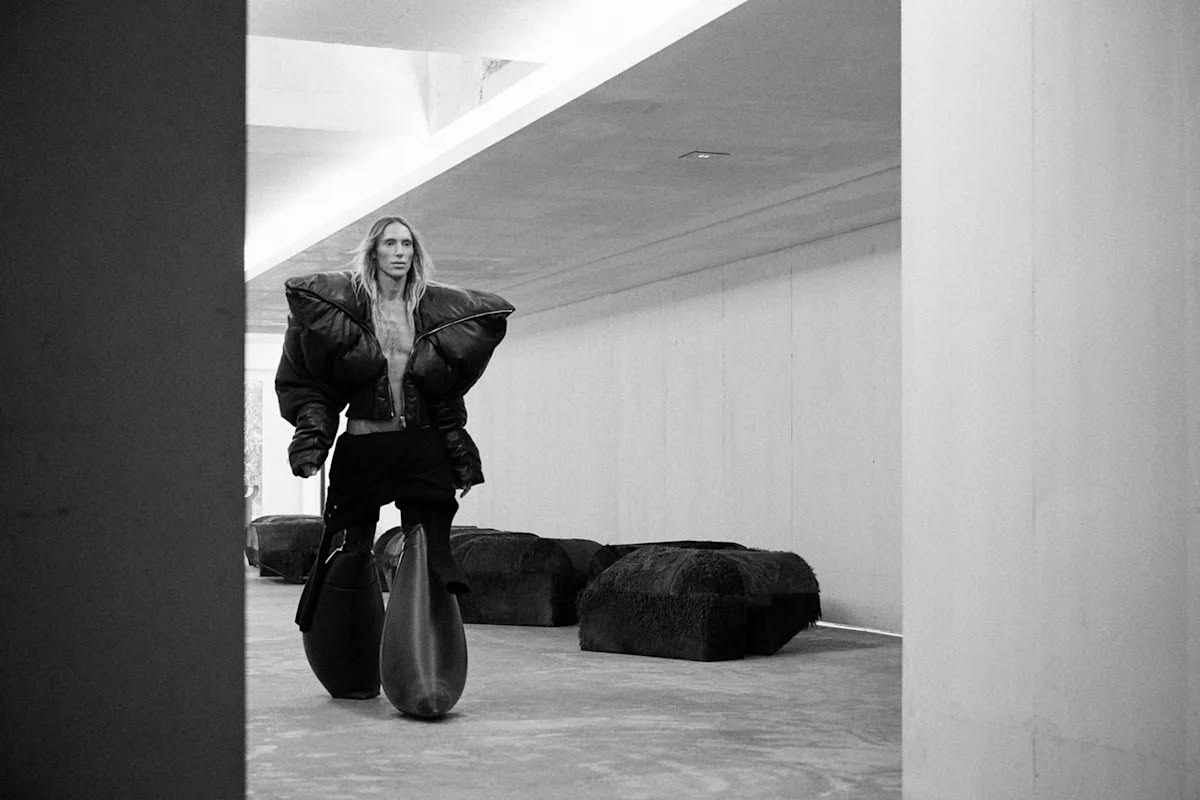
Rick Owens’s autumn/winter 2024 menswear show, presented on January 18, 2024, makes a useful starting point. His official Porterville notes credit inflated rubber pull-on stretch boots to a collaboration with London designer Straytukay. They also credit Leo Prothman’s improvised interpretation of the Kiss boot and garments made from discarded bicycle tyres by Matisse Di Maggio.
These are specific collaborations, not a vague mood called dystopian. The inflated boots alter the body’s outline before any graphic enters the picture. The tyre pieces bring an existing material history into clothing. Owens makes the silhouette feel resistant to ordinary expectations of human scale. The clothes do not politely improve the wearer. They propose another kind of wearer altogether.
Balenciaga weaponised the scuff
Balenciaga’s Paris sneaker campaign arrived in May 2022 under Demna. Its torn, filthy-looking footwear images made deterioration the subject rather than a defect to retouch. But precision matters here: the campaign’s most extreme images were exaggerated presentations, not a straightforward picture of every retail pair. PAPER distinguished those images from both the limited “extra destroyed” release and less distressed versions.
That distinction does not weaken the visual argument. It exposes the construction of it. Wear became an authored surface, as deliberate as a pristine white sole. The uncomfortable question is not whether a new shoe should look old. It is why one kind of artificial finish gets called refinement while another is treated as an offence against civilisation.

Even Supreme’s denim carries damage
Supreme’s Distressed Selvedge Trucker Jacket dropped on August 22, 2024, according to the Supreme Community archive. Its product description specifies 13-ounce Japanese denim, a heavy wash and hand-applied distressing, in washed indigo and washed black. This is a concrete example of streetwear treating fading and damage as construction decisions, not styling accidents.
The point is not that Supreme suddenly discovered abrasion. It is that a familiar trucker shape can lose its showroom neutrality through treatment alone. Place that exhausted denim beside distressed leather, a visibly worked belt or hard metal closures and the outfit develops interruptions. Clean dressing smooths the transitions. This approach wants you to notice where one surface fights another.
Tattoo finish, gothic punctuation
Ed Hardy’s spring/summer 2024 arrival at JD, documented by the retailer on May 13, offered tattoo-inspired graphics across roomy T-shirts, denim shorts and fleece. Don Ed Hardy’s artwork supplies a different relationship between body and garment: the print behaves less like discreet branding than a second skin. “Tattoo finish” here describes that visual density, not a special textile process.
Chrome Hearts provides another kind of interruption. Its December 2021 collaboration with COMME des GARÇONS comprised 19 customised pieces, including a double-layer blazer with floral overlay and exposed seams, plus shirts with conspicuous Chrome Hearts button closures. The collaboration is a useful corrective to reducing the label to gothic lettering: its vocabulary also works through hardware, altered tailoring and material insistence.

The music makes the clothes move
The musical connection does not need an invented fit identification. An April 8, 2025 interview describes Destroy Lonely wearing a heavily distressed vintage T-shirt with charcoal eyeshadow. A December 2, 2025 backstage report on Ken Carson describes an audience in black leather, chunky boots and Rick Owens DRKSHDW sneakers. That last observation concerns the crowd, not a claim that Carson wore every item himself.
Here, the look becomes a shared language without becoming one uniform. Gothic graphics, faded denim, worn leather and unusual footwear can communicate intensity before a track starts. None is automatically rebellious; all can become another checklist. The interesting outfit is the one that changes their relationship. Clean has not vanished. It simply no longer gets to mistake good manners for imagination.
From the VANDAL notebook: Destroy Lonely