A grandmother's thimbles and the remains of a mammoth belong to radically different scales of memory. One fits inside a hand; the other dwarfs the human body. In Mammoth, Nick Cave brings them into the same imaginative territory. His exhibition at the Smithsonian American Art Museum constructs a world in which domestic remnants and invented prehistoric evidence can speak to one another. The question is not simply what has disappeared. It is what we choose to notice before it does.
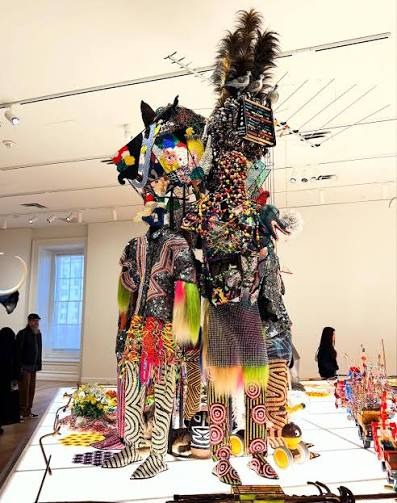
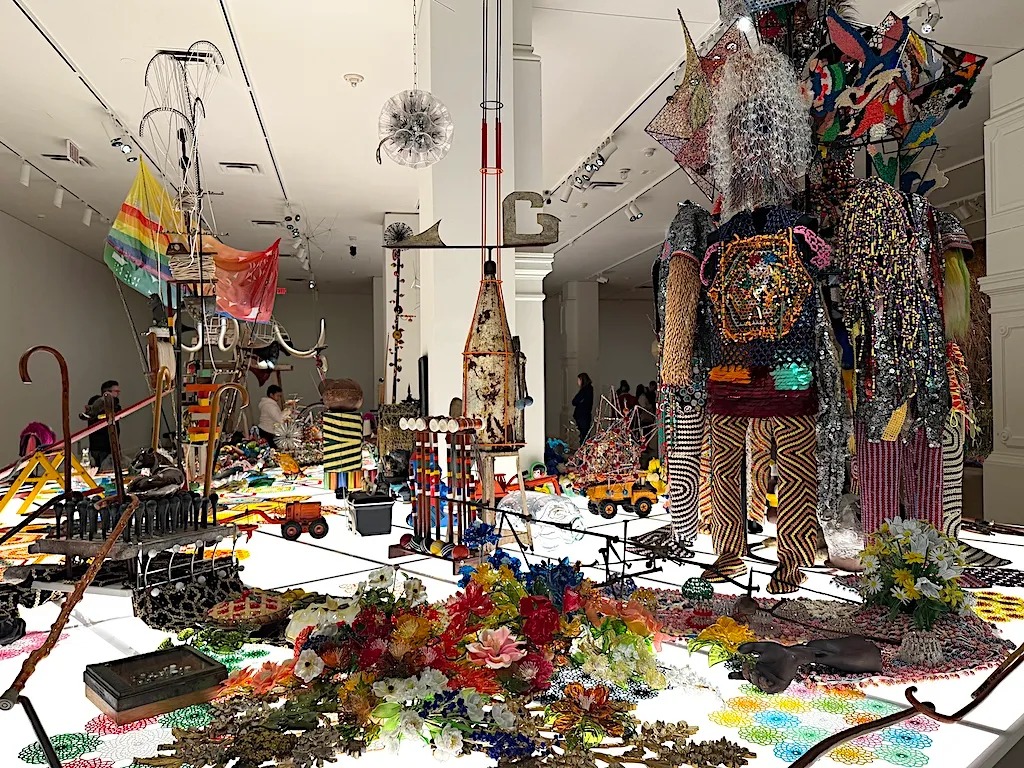
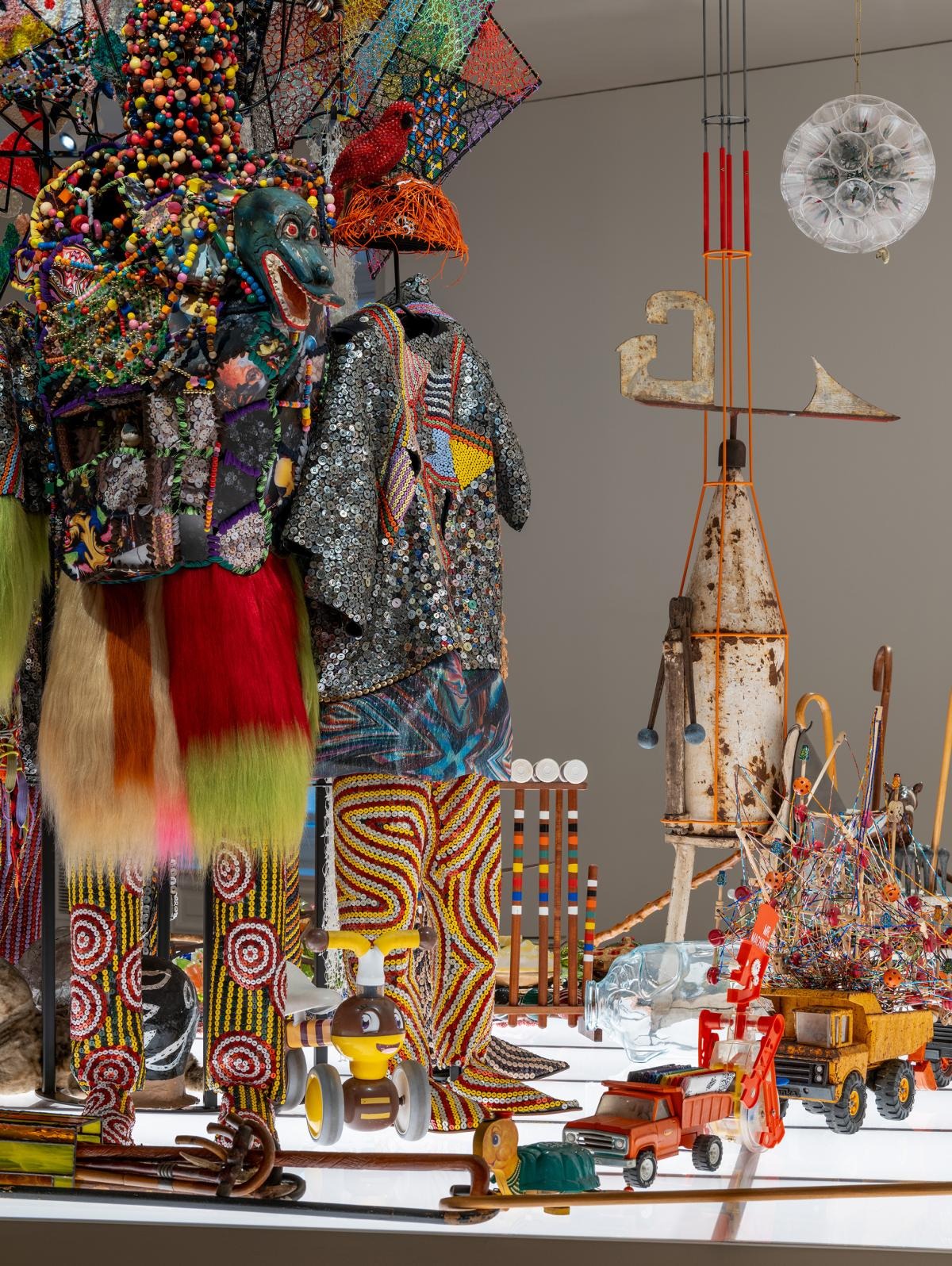
Cave's materials refuse a clean separation between the monumental and the minor. The museum describes crafted mammoth hides and bones, a projection that brings the extinct animals imaginatively back to life, and hundreds of altered found objects arranged like paleontological specimens on a vast illuminated table. Vintage tools share this field of attention with his grandmother's thimble collection. These are not archaeological discoveries. They are the components of an artist-made universe, using the visual authority of a specimen display without pretending to deliver scientific evidence.
Beyond the Soundsuit
Cave is internationally associated with Soundsuits: exuberant forms that bring sculpture, clothing and performance into contact. The Smithsonian identifies racialized police violence as the impetus behind their original creation. That history matters because it prevents his work's visual extravagance from being mistaken for an escape from politics. In Cave's practice, imaginative transformation has never required leaving the conditions of the body behind.
But Mammoth should not be reduced to a Soundsuit retrospective. The museum presents it as a new body of work, with a focus that is simultaneously more expansive and more intimate. Its account places Cave's family history in rural Chariton County, Missouri, his connection to that landscape and the workings of his creativity at the centre.
The change of scale is significant. A wearable sculpture holds the possibility of bodily activation. An environment of imagined remains asks the human body to find its position among things that exceed it. Visitors are invited to walk among Cave's fantastical constructions. That relationship makes the spectator neither the sole subject nor the unquestioned measure of the scene.
The ordinary object gets another life
A thimble protects a finger engaged in repetitive work. A tool carries the suggestion of a task, a hand and a particular way of making a living. Placing such objects within a specimen-like arrangement changes the terms on which they are read. They become evidence, although the evidence they offer is cultural and personal rather than prehistoric. What looks negligible in one system of value can become indispensable in another.
Museum display is itself a technology for assigning importance. Light something carefully, separate it from everyday circulation and give it room, and its status changes. Cave uses that capacity to elevate objects that might otherwise be overlooked. The family connection keeps this operation from becoming an abstract exercise in collecting: some remnants carry relationships, not just interesting surfaces.
The mammoth, meanwhile, introduces a different pressure. Extinction makes survival impossible to treat as an unlimited resource. Beside it, the modest persistence of a tool or thimble starts to look strange: objects can outlast the circumstances that made them useful, while whole forms of life vanish.
Possibility without amnesia
Organized by Sarah Newman with support from Anne Hyland, Mammoth frames the relationship between people and a changing environment through grief as well as possibility. Its fantasy does not need to erase loss to be generative. Instead, the artist's constructions propose that the remains of a world can become materials for thinking beyond its existing arrangements.
That is a more demanding proposition than optimism. It asks what kinds of attention a different future would require: attention to family knowledge, to overlooked labour, to landscapes and to things whose value is not immediately legible. Cave builds another world from this one's leftovers. The challenge is to stop treating them as leftovers.